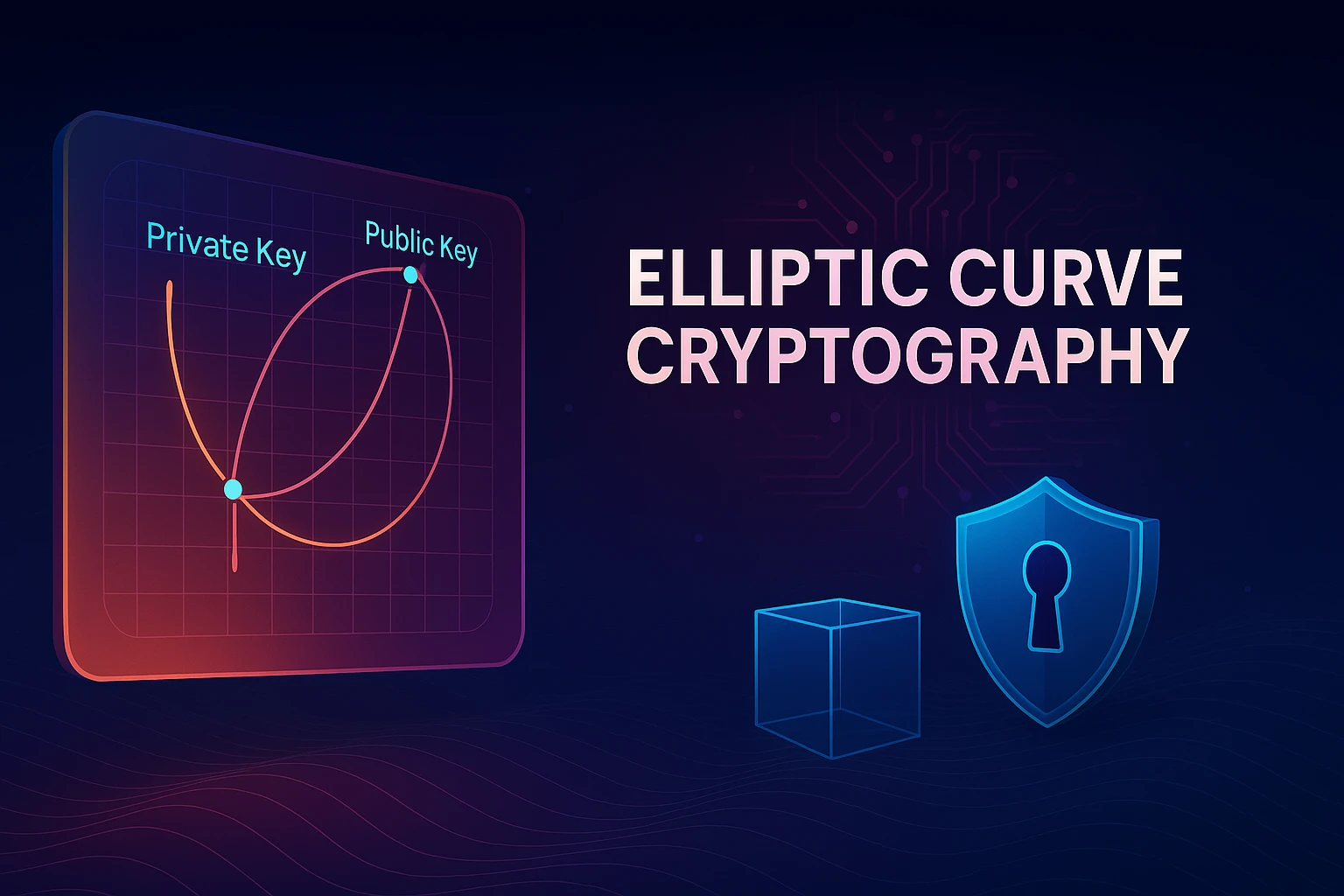
Project overview
ECDLP Solver is an advanced cryptographic research project aimed at exploring and accelerating the resolution of the Elliptic Curve Discrete Logarithm Problem (ECDLP) — the mathematical foundation underlying the security of widely-used elliptic curve cryptographic systems like secp256k1 (used in Bitcoin, Ethereum, etc).
At the core of elliptic curve cryptography is the equation:
Q = d * G
Where:
- G is the generator point on the elliptic curve,
- d is the private key (a scalar),
- Q is the resulting public key (a point on the curve),
- and * denotes scalar multiplication on the curve.
The challenge is to find d given G and Q — a task believed to be computationally infeasible for large key sizes due to the hardness of the ECDLP.
However, the ECDLP Solver takes a novel approach:
- During scalar multiplication, we track all intermediate points leading up to Q — not just the final result.
- Due to the nature of point addition and doubling in secp256k1, many of these intermediate values are repeated or collapsing, resulting in significantly fewer unique points than the theoretical maximum of 255 per key.
- Each intermediate point is treated as a potential public key and mapped back to its corresponding scalar candidate.
- This approach yields a multi-candidate space for every public key — turning one search into hundreds, and filtering out redundant steps based on observed repetition patterns.
Thus, for a single observed public key Q, the system may identify up to 255 associated scalars, each representing a different private key candidate derived from distinct intermediate stages of the multiplication. In practice, due to overlapping point reuse, the number of unique candidates is often an order of magnitude lower, making brute-force and precomputed table attacks dramatically faster.
All data is processed and exchanged through a high-performance, distributed REST API that logs and analyzes point relationships in real-time — ideal for cryptanalysis, educational research, and zero-day crypto investigations.
What is ECDLP and Why Does it Matter?
The Elliptic Curve Discrete Logarithm Problem (ECDLP) is the central hard problem upon which the security of elliptic curve cryptography (ECC) is built. It can be stated as:
Given two points G and Q on an elliptic curve such that
Q = d * G,
find the scalar d.
Here, G is the known generator point, Q is the public key, and d is the unknown private key.
The difficulty of reversing this operation — recovering d from Q and G — makes ECC highly secure even with relatively small key sizes (e.g., 256 bits in secp256k1). Unlike RSA, which depends on integer factorization, ECC offers comparable security with significantly less computational overhead.
In short, ECDLP is a cornerstone of modern cryptography. Any advancement in solving or even optimizing the analysis of ECDLP — like the techniques used in this project — could have profound implications for cybersecurity, cryptanalysis, and the future of digital privacy.
Project solution
The ECDLP Solver leverages an unconventional, optimization-centric strategy to accelerate the discovery of private keys associated with known public keys on an elliptic curve — specifically targeting the secp256k1 curve used in modern cryptographic systems.
The core idea is rooted in the observation that scalar multiplication on an elliptic curve is not a black box — it’s a deterministic sequence of point additions and doublings, each producing a traceable intermediate point. Normally, scalar multiplication:
Q = d * G
is executed through a double-and-add method using the binary representation of d:
If d = d_0 + 2*d_1 + 4*d_2 + ... + 2^{n-1} * d_{n-1},
then Q = d_0*G + d_1*(2*G) + d_2*(4*G) + ...
In this representation, every nonzero bit of d corresponds to a specific point P_i = 2^i * G. Thus, the complete scalar multiplication is a summation of a subset of these intermediate points.
Insight 1: Intermediate Points as Public Key Candidates
Each intermediate point P_i can be interpreted as a potential public key for some smaller scalar:
P_i = k_i * G, where k_i < d
Therefore, instead of viewing Q as a single immutable endpoint, we treat every P_i as a valid but partial candidate for a private key — allowing us to construct a multi-candidate spectrum for every public key. This gives:
For every observed Q, we generate a set of candidate points:
{P_0, P_1, ..., P_n}, and reverse-map them to k_0, k_1, ..., k_n
In an ideal case, this would produce up to n = 255 candidate scalars per Q.
Insight 2: Repetition and Point Collapsing
In reality, due to the structure of elliptic curves and the presence of point overlaps (e.g., P_i = P_j for different i ≠ j), the number of unique intermediate points is often far below 255. Empirically, this number may collapse to as few as 10–30 unique points — reducing the effective search space drastically.
This yields a major performance gain:
- Instead of computing and comparing 2^256 possible keys,
- We only scan 10–30 reusable candidates per target.
Insight 3: Applying the Prisoners’ Box Strategy
The algorithm also borrows conceptual inspiration from the 100 prisoners problem, where each prisoner opens boxes in a deterministic path starting from their own number — significantly increasing the group’s chance of survival.
Similarly, our solver follows deterministic chains of intermediate points starting from an index derived from Q mod n, and walks the chain:
Q -> P_i -> P_{i±k} -> ...,
until a cycle is found or G is hit.
This drastically reduces random memory access and allows bounded, structured traversal, improving locality, caching, and parallelization.
65K+
Speed-up Over Traditional Brute-Force in Specific Cases
51KKK+
Points Processed Per Second (Cluster Average)
17x
Average Number of Duplicate Points per Scalar Walk
255→12
Candidate Space Narrowed by Structural Deduplication
CryptoCorp: What Everyone Asks?
Curious about how deep reconnaissance really goes, what’s legal, and what tools actually matter? Here are the most common — and most revealing — questions about recon, answered with clarity and just the right amount of sarcasm.
No, not exactly. We're studying its structure really, really closely... at scale... with clusters... and math. Think of it as "performance-oriented cryptographic introspection" — not active sabotage. Unless, of course, someone left a backdoor open.
Great question. In scalar multiplication, every bit of the private key contributes to one point addition. We treat each of those intermediate points as a potential key — because sometimes, the halfway point leaks more than the end.
No — secp256k1 is still safe (for now). But if your security depends on “brute-force would take forever,” and someone comes along with a way to make “forever” 65,000 times faster… you might want to reconsider the word forever.
Absolutely — NVIDIA A100 GPUs running highly optimized CUDA C kernels. No quantum fairy dust needed when you have thousands of CUDA threads chewing through elliptic curve math in parallel. It's brute-force, yes — but the kind of brute-force that deserves a PhD and its own datacenter.
Absolutely not. Unless it’s your own crypto and you forgot the key. Or it’s a CTF. Or it’s a very convincing blockchain-themed escape room. Otherwise: educational use only — your moral compass is your responsibility.